Over thirty percent of the average home's energy expense is committed to heating water. The newest technology in the water heater industry is the tankless water heater. The manufacturers of the gas-fired tankless water heaters claim their products can cut energy costs up 50%. The questions is it time to switch is probably crossing your mind.
Probably not. Gas tankless water heaters, which use high-powered burners to quickly heat water as it runs through a heat exchanger, were 22 percent more energy efficient on average than the gas-fired storage-tank models in our tests. That translates into a savings of around $70 to $80 per year, based on 2008 national energy costs. But because they cost much more than storage water heaters, it can take up to 22 years to break even—longer than the 20-year life of many models. Moreover, our online poll of 1,200 readers revealed wide variations in installation costs, energy savings, and satisfaction.
With the help of an outside lab, we pitted Takagi and Noritz gas-fired tankless water heaters against three storage water heaters. We didn't test electric tankless heaters because many can't deliver hot water fast enough to replace a conventional water heater if groundwater is cold. Even in areas with warm groundwater, most homeowners would need to upgrade their electrical service to power a whole-house tankless model.
Our tests simulated daily use of 76 to 78 gallons of hot water. That's the equivalent of taking three showers, washing one laundry load, running the dishwasher once (six cycles), and turning on the faucet nine times, for a total of 19 draws. While that's considered heavy use compared with the standard Department of Energy test, we think it more accurately represents an average family's habits. We also ran more than 45,000 gallons of very hard water through a tanked model and a Rinnai tankless model to simulate about 11 years of regular use.
Here's what else we found:
Water runs hot and cold
Manufacturers of tankless water heaters are fond of touting their products' ability to provide an endless amount of hot water. But inconsistent water temperatures were a common complaint among our poll respondents. When you turn on the faucet, tankless models feed in some cold water to gauge how big a temperature rise is needed. If there's cool water lingering in your pipes, you'll receive a momentary "cold-water sandwich" between the old and new hot water. And a tankless water heater's burner might not ignite when you try to get just a trickle of hot water for, say, shaving.
Nor do tankless water heaters deliver hot water instantaneously. It takes time to heat the water to the target temperature, and just like storage water heaters, any cold water in the pipes needs to be pushed out. And tankless models' electric controls mean you'll also lose hot water during a power outage.
Up-front costs are high
The tankless water heaters we tested cost $800 to $1,150, compared with $300 to $480 for the regular storage-tank types. Tankless models need electrical outlets for their fan and electronics, upgraded gas pipes, and a new ventilation system. That can bring average installation costs to $1,200, compared with $300 for storage-tank models.
Tankless units might need more care
During our long-term testing, an indicator on the tankless model warned of scale buildup. We paid $334 for special valves and a plumber to flush out the water heater with vinegar. Many industry pros recommend that tankless models be serviced once a year by a qualified technician. Calcium buildup can decrease efficiency, restrict water flow, and damage tankless models. Experts suggest installing a water softener if your water hardness is above 11 grains per gallon. Ignoring this advice can shorten your warranty.
Efficient storage models are pricey
We also tested the $1,400 Vertex, a high-efficiency storage water heater by A.O. Smith. The manufacturer claims its installation costs are similar to a regular storage model. But its high cost offsets much of the roughly $70 per year the Vertex will save you. Instead, we recommend buying a conventional storage water heater with a 9- or 12-year warranty. In previous tests, we found that those models generally had thicker insulation, bigger burners or larger heating elements, and better corrosion-fighting metal rods called anodes.
Speak to someone who specializes in HVAC in Denver about their thoughts and finding on tankless water heaters. They might have more of an insight to how they run, the cost as well as the pricing.
Article Source: http://www.consumerreports.org
Showing posts with label hvac in denver. Show all posts
Showing posts with label hvac in denver. Show all posts
Thursday, October 28, 2010

Tankless Water Heater Ratings
Posted by: Denver Heating
With our tankless water heater ratings, you can cut through all of the sales hype and find value. We have researched the brands from every part of the world and using our years of hvac industry service experience provided our unique system of ratings. It truly is like taking a repairman with you while you shop!
 We have given each brand a rating of from 1* to 5*. A rating of 5* means that, if we were shopping for our own home, that is the brand we would choose (if it was available). When more than one brand is available with a 5* rating, we would choose the least expensive brand. When an NA appears in the place of a rating, it means that the brand does not have a model available in that group or there was insufficient information to fairly rate it.
With our tankless water heater ratings, you can cut through all of the sales hype and find value. We have researched the brands from every part of the world and using our years of hvac industry service experience provided our unique system of ratings. It truly is like taking a repairman with you while you shop!
 We have given each brand a rating of from 1* to 5*. A rating of 5* means that, if we were shopping for our own home, that is the brand we would choose (if it was available). When more than one brand is available with a 5* rating, we would choose the least expensive brand. When an NA appears in the place of a rating, it means that the brand does not have a model available in that group or there was insufficient information to fairly rate it.
 We have rated both whole house and point of use tankless water heaters. For an accurate comparison, we have divided the whole house units into three groups based on the fuel they use to heat the water.
If you are looking for a unit for your shower, you can compare brands on our electric shower ratings page. For more information on water heaters, check out the site HVAC in Denver.
Tuesday, September 14, 2010
Soldering as a HVAC Repair Method
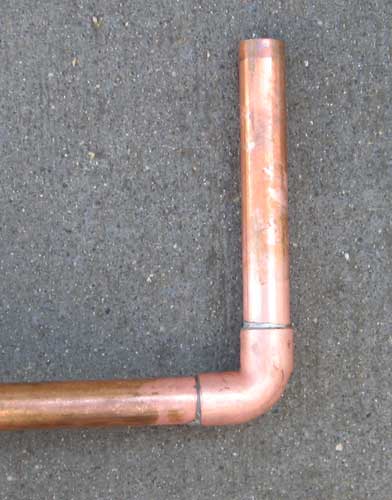
The big payday on HVAC jobs is when you get to replace a whole system. However there are many simple fixes, both temporary and permanent that can be used to save customers a great deal of money. One of these is soldering metal.
One of the first things that hvacr techs learn about soldering is that you cannot solder copper pipe with water still in the pipe. Before any repairs can start, the pipe needs to be drained, closed and dried. This causes problems because sometimes if there are multiple leaks say in a water cooling system, water might keep migrating down as you try and repair the pipe.
Fortunately there are a few tricks to try and work around this problem. One is called the bread trick. Take some white bread without the crust and stuff it into the pipe above the area you need to solder. This only works for very slow leaks, but it is effective because the bread swells as it absorbs water. Once water pressure is restored, the bread will dissolve. However you may need to remove strainers along the system.
The more technical method that I have seen HVAC in Denver workers use are pipe freezing machines. This freezes the pipe and its contents solid so that it can be cut. This is much more expensive and uses highly specific equipment, however it works perfectly, unlike the jerry rigged bread method. Just be careful to only freeze the area you are working on. Freezing the whole pipe can cause it to burst.
When working on pipes that contain coolant, Denver air conditioning technicians use different technology called brazing. Brazing uses oxyacetylene for refrigeration. Instead of lead, use silver soldering. Silver chemically binds with copper to make a leak free joint. The oxyacetylene torches are used to heat the whole pipe up to above five thousand degrees Fahrenheit. Of course this means you need to use the proper safety equipment for these kinds of torches. This especially means a welding mask to save your eyesight.
To properly braze, you need to clean the pipe. Once it sets it should be solid. The inner and outer joints need flux applied before heat. The torch should not heat the solder. Instead evenly heat the pipe so that the solder makes a uniform fit. Use just enough solder for a tight fit. Too much and it could break up and foul up equipment. The final step is to perform a pressure test. Apply soap to the outside of the pipe and look for bubbles indicating an improper seal. Once pressure is applied, any drop indicates a leak.
Subscribe to:
Posts (Atom)


